
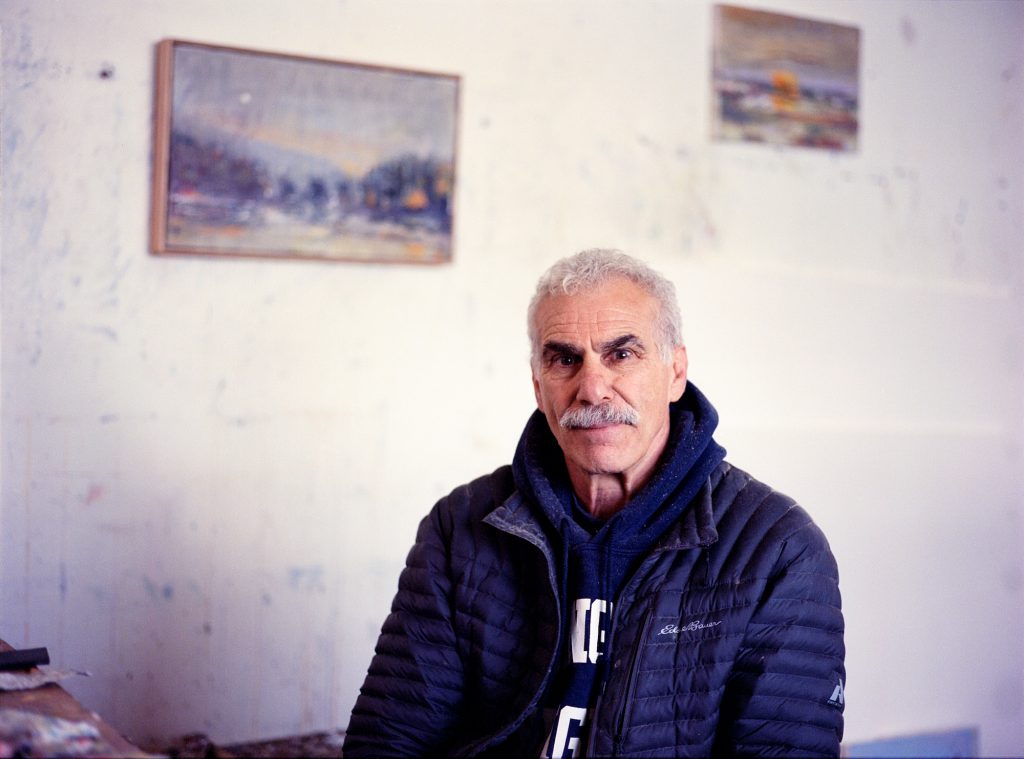
I met William Chickillo a few years ago at Skylake Gallery which serves as his gallery, studio, and workshop in Fleetville, Pennsylvania. I had stopped by at the time, not to see his art but to take some photos of his building with my drone. I had a terrible drone at the time and I was terrible at flying it – but he was nice enough to let me give it a go.
Upon seeing his large abstract pieces hanging in his gallery, I mentioned I wanted to come back someday and interview him for The Watercolor Gallery. Even though he primarily works in oil I knew there would be a lot to learn from for artists of all mediums. So just last month, a few years after meeting him, I stopped by. We talked for over an hour and he let me take his photograph on film since that is one of my hobbies. He also gave me a tour of his studio area, his workshop where he builds his frames by hand, and his gallery space. If you’re ever in his area I recommend stopping by Sky Lake Gallery.
This interview is in a different style than my previous interviews. Here are some audio snippets of our conversation that you can let play through. Below that are some quotes that I transcribed from our conversation interspersed with some of his work. I hope you like this interview and thanks to Mr. Chickillo for taking the time.
Read full transcript
[00:00] Introduction
Colin Devroe: Hello, and welcome to an interview with William Chickillo on The Watercolor Gallery. I’m very excited to bring you something very different for The Watercolor Gallery. After 11 years, this is our first audio interview, and I hope to do more of them in the future.
The reason this one is an audio interview is because William Chickillo’s studio is just about 10 or 15 miles from my front door, so it was an opportunity to get together. I met William a few years back and mentioned the website and the gallery. I said I’d love to interview him someday, and so, finally, a few years later, we’re here.
He was also gracious enough to let me photograph him, so the photographs that you see on the website were taken by me. I am learning film photography at the same time as toying with watercolor, so it was a real pleasure to be able to mix those two hobbies of mine. Thank you to Mr. Chickillo for letting me do that.
The conversation jumped right off the second I walked into the building. I expected to arrive at his gallery and maybe be able to sit down and have a conversation with him, much in the same style as many of the other interviews that you see on the website, but it just did not happen that way. We got into a conversation immediately. Fortunately, I hit record a few moments into the conversation, and I let it roll the entire time.
I have edited out pieces and pared it down for time because we were walking around his building—which is great, by the way. If you get a chance to stop there, the information will be on the interview for the location, and, of course, his website and Instagram and so forth.
He has a nice gallery when you first walk in, where you get to see his work. He has very large canvases, and many of them are in his gallery there. Right behind the gallery is his studio, where he does his work. It’s just great to see. I wish I had taken more pictures, but, in some way, I hope that you just go someday and see his place.
He also has a workshop in the basement that he very graciously gave us a tour of. He showed us the press and the different ways he does his framing down there in his little workshop. It was really, really great. I’m quite jealous that he has such an awesome workspace.
This interview is not in the same style as we usually do. Here on The Watercolor Gallery, we usually try to cover things like: How did you start in watercolor? How did your gear change over the years? What are some of your inspirations?
Because this was such a meandering conversation, it goes all over the map. It’s everything from talking about abstract art and the different mediums that he uses to his time as a teacher. I hope that you enjoy this. It is very different. Maybe you could queue it up to listen to on your ride into work or something.
I’ve tried to pare it down slightly. I’ve also pulled some quotes and added links to artists and other things he mentions on the website. When he said something kind of poignant, I pulled it from the conversation and put it—loosely quoted—on the site, too. Maybe you can get some inspiration from that if you don’t have time to listen to the whole audio interview.
My thanks, of course, to Mr. Chickillo for taking the time. This was really fun to put together—a lot of work, too, but really fun. Maybe we’ll do more of these in the future. I hope that you enjoy it.
Thank you very much for visiting the website. If you find some time, share the website with other artist friends that you have. If you want to submit watercolor paintings to be featured on the gallery, or submit artists that you’ve stumbled across, please send me an email through the website. You can also follow @h2ocolor and send a post there. I would love to be exposed to more art.
Specifically, because this interview is more about abstract art, if you find some great watercolor abstracts, please send them my way. Thanks again, and I really hope you enjoy this interview with William Chickillo.
[05:02] Knowing when a painting is finished
Colin: How long does a large piece typically take you?
William Chickillo: They could take years sometimes, and sometimes they could take one afternoon. I have no idea.
Colin: Well then, how do you know when you’re done? That’s the ticket.
William: Well, I can only quote de Kooning: “Stop at an interesting place.” Because you can open it up again at any time and say, you know, you’re looking at that painting right now and saying, “Maybe that one little area—I could change the value.” Well, as soon as you do that, you just open it up for another possibility. So, in essence, you have to just be satisfied with what you’ve got at that time. That’s probably why abstraction really interests me the most.
Colin: Because it’s up to your interpretation at the moment.
William: Exactly. Whereas, if you’re into realism, it’s focused in on every little odd thing. That’s all solved for you. But I happen to like that element of surprise, because I think that’s where the art lies—not so much in the rendering of making it what you think it is, or what I think it is, but the possibilities of what it could be.
Colin: I have a hard time finding many watercolorists who deal in abstract, and I think the medium doesn’t allow you to do it—or it just isn’t as freewheeling as some of the other mediums.
William: As you think, because once you stain that paper, you’ve got to live with that. Whereas, guess what? When I’m doing an oil, if I don’t like it—
Colin: You go over it again.
William: Or I wait until it dries and grind it off.
This one here on the floor started out as a watercolor and ended up as—now, that’s an older piece. If you look at this work, you can see that’s probably an older piece. I’m going to send that one off to Texas because I happen to think that it kind of explains a lot of other things that are going on.
But look at the clouds in that painting there. That’s really typical watercolor.
Colin: Yeah, you’re right. That’s what you would expect from a watercolor painting.
William: Large blocks of areas that are translucent, showing you just the shades and objects and where they are positioned, more so than interpreting the entire area.
Colin: Exactly. I like it. Nice work here, though. I love when you can see a large volume of someone’s work in one spot. It’s nice.
[07:47] Monoprints and experimentation
William: Well, I can take you downstairs in a second. But this is the painting studio, and underneath me here, Colin, are hundreds and hundreds of monoprints. I’ll explain what a monoprint is downstairs, but there are stacks of them.
Colin: I see that.
William: They’re pretty close to watercolors, in essence, because what they are is inks with a water base, painted on a Plexiglas plate and run through the press once. So what is on that plate is now transferred—married to the paper.
Colin: So it’s like printing. I mean, it’s like printing.
William: It’s painting, printmaking—it’s all together, and it’s beautiful. I happen to like it very much.
Colin: And you probably like—there’s a little bit of randomness to it?
William: Yeah, because you never know what you’re going to get.
Colin: Well then, there’s a lot of randomness to it.
William: Yeah, because once you run it through that press, you don’t know how it’s going to react.
Colin: Yeah, that’s pretty wild. So do you use that as a base and then go from there?
William: Not necessarily, but what it does is open up my possibilities when I do get in here. I think what it does is free me up. It frees me up to think about what I did downstairs, so I’m not encumbered by my own techniques. I have to free myself up to be able to—
Colin: I like that palette, by the way. I like what you’ve got going on here, because there’s some bright stuff going on in your other work. There’s a lot of white shining through on some other ones. I like this palette right here.
William: Well, it all happens right there. That’s where it happens.
Colin: The purple—I really like that. And this little dude over here hanging out. Pretty cool.
[10:04] A moon added later
William: I could tell you a story about that painting. When I did it, the moon wasn’t in it. Then one afternoon I was looking at that thing—and that place is up on the Delaware River, Tamarack. One day I was up there with my son and the moon was just coming up over there. I said, “You know, that’s a possibility.” So I put it in as an afterthought, and I happen to like it.
Colin: Yeah, that’s pretty neat. I like it a lot. It works.
[10:34] Plein-air work and studio work
Colin: When you’re saying that some of these pieces take you years, your website says that you work en plein air. So I’m guessing that you might start some pieces and then—
William: A lot of watercolors, a lot of drawings. I’m never too far from that.
Colin: But you don’t start and finish a piece out there if it takes you that long.
William: I mean, I can, but not generally. Because what occurs here, I can’t do out there. There’s something else that happens here. The studio is much more physical, in terms of—I can scrape things down, I can let them dry. I could do stuff in here that I can’t do outside.
Colin: Well, if somebody saw this next to their lake up on the Delaware River, they might get a little—
William: They might be sending me a citation. But I could do stuff in here that I can’t do outside.
Colin: Because you’re limited to what you could do there.
William: Yeah. But, by the same token, there’s an immediacy out there that I can’t always do in here.
Colin: I like plein air because it rushes you a little bit because of the light. I like constraints in art. I think constraints in photography, art, music, jazz, whatever—it forces creativity because you have less of a toolset. I think with plein air, if you have to get something moving because everything is changing on you, something nice can happen as a result of that push.
William: Well, I had a teacher once say, you know, painting out in cold weather—which I’ve done—hurts. And you get down to business fast.
Colin: Yeah. Painting in the winter hurts.
William: You’ve got to live with it and move on to the next thing. I continue that because this building, as you can feel, is not heated.
Colin: Yeah.
William: Everything I do hurts—especially when I do the monoprints downstairs. I’ve got a little space heater just going enough to keep my hands warm. But I’ve had it where I’m printing and the paper that I just dampened is freezing on the table before I print it. So I get down to business as quickly as I can.
[13:10] The blank paper and the “frustration zone”
William: The best thing you can learn about—whether it’s plein air, or just dealing with objects, whether it’s even still life—is to understand that you have to start somewhere. Where do you begin? Most amateurs are afraid of white paper. They’re afraid of this.
Colin: Yeah, the blank canvas is scary.
William: That, to me, is just the opposite. I can’t wait to destroy it. Because what happens is, any landscape painter or plein-air painter will tell you, you’re going to lose your place.
Colin: You’re at some point in the frustration zone. Is that what you mean? Like when you get to the point where nothing seems like it’s working, but it’s almost going to work in a second?
William: It can’t, because it’s everywhere but nowhere. You’ve got to pull that thing together.
Colin: Yeah, I know exactly what you’re talking about. Finding that anchor is important.
William: Yeah, because without that anchor, nothing else can be pulled out.
Colin: Right. I feel that.
[14:21] Large canvases and the appeal of abstraction
Colin: So you must not like money, because you deal in very large canvases. I get told that—I shoot film now, and the first thing people say to me is, “You must not like any money.” I have my own darkroom and I’m using film, and every time I hit the shutter I hear my cash register ring.
William: Actually, Colin, it’s just the opposite. I like money. The way to make a lot of money is big canvases.
Colin: I understand.
As I get older, I appreciate abstract more than I did when I was younger. I don’t know why. Very early on, when I started getting into looking and being even critical of art—when I started the website, I started it in 2010, so we’re already 11 years in—I don’t think I would have had the appreciation for your kind of work then that I do now. I think maybe I just wasn’t seeing enough stuff to give me a vocabulary.
William: Yes, and seeing good stuff, because there’s a lot of bad abstraction, too. It’s too easy to go bad. It’s a lot harder to hit it. I always like to look at abstraction as: If it’s going to work—and Picasso did it—you’d better know how to put it together before you take it apart.
[15:48] Reworking a painting
William: You have to forgive this place because it’s a work in progress here. This is the one I’m doing right now. I’m looking at this, and once it got into the frame, I started seeing some other things. I’m looking at this and I think this is too broad. I could put another layer in here. I could put another value change. I could do a little bit more with this. I could extend this. So before this is completely completed, I’ll probably hit it one more time.
Colin: Have you ever read about Leonardo da Vinci? Later in da Vinci’s life, when he was doing his anatomy, he just kept adding to the paintings after a while because he started to know exactly where all the muscles were and stuff—when you’re literally taking cadavers apart and know where everything is. But he was hitting the Mona Lisa for 14 or 15 years.
William: Yeah, it was a continuous thing.
Colin: So you’re in good company when you keep going back and touching stuff later, because that’s what he did.
[17:01] The press and layered prints
Colin: Wow, look at this thing.
William: This is Charles Brand. It was made by Charles Brand. He’s dead now. But this was the press I had when I was in school in Maryland. They shipped it up here in pieces, and we assembled it once we got it into the building.
Here’s the Plexiglas plate, right? It’s pretty much painted directly onto the plate with inks. Then the paper is put over the top and run through the press. But then I do it several times to get several different layers.
Here’s a watercolor. I’m about ready to destroy that, but I want to let some of it come through. I want to let some of the watercolor come through, as well as the next layer of inks. So it’s experimental. But it’s 300-pound Arches, which is great paper because you can do some great things.
Colin: A controlled experiment.
William: Yeah, always—always experimenting. Because you never know where the next thing is going to come from.
Colin: That’s really neat.
[Phone rings; brief interruption.]
[18:50] Joseph Opshinsky and other artists
William: Joseph Opshinsky was a student of mine at Keystone, and he’s doing some really terrific stuff. He also does watercolors outside, so I would get ahold of Joseph Opshinsky, too. That’s the kind of thing he does. He goes out and looks for that kind of—I don’t want to call it nostalgic—industrial—
Colin: I know what you’re saying, though.
William: Because he does a great many things. He has one of Dick’s Sporting Goods—or Bill’s in North Scranton—with the facade. He has a lot of cool stuff, and if you go on his Instagram page, you’ll see it. I’m on Instagram, by the way.
Colin: Yeah, I followed you the other day, so I’ve got you on there.
William: That’s a good place to see what’s going on.
[19:52] Artistic influences
Colin: Well, I think most of my questions that I normally would ask you have already been answered, and I’ve been recording the entire time because we didn’t really know.
If I had any other questions to add, I’d probably just ask you to mention some modern or recent influences. I know on your website you list some of the influences that started you out in things, and maybe those have been updated or whatever. You have George Inness on there and a couple of others.
If you can think of anybody recently that you’ve come across, who you’ve been impressed with or who has influenced you in any way—whether they’re alive or dead, or just work that you’ve seen.
William: Well, they’re both dead now, but they were alive when I was at MICA: Fairfield Porter and Michael Mazur. Michael Mazur was terrific. Fairfield Porter is considered the father of contemporary East Coast American Realism. Meeting him was an incredible experience.
But I still have some teachers who are alive. Paul Moscatt is still alive. He’s on Instagram. He’s in his late 80s.
There are a bunch of contemporary painters I follow now who I think are really, really quite interesting. I think Eric Aho is doing some nice things. I have a really good friend, John Evans. He’s a painter and a friend of mine, and he’s doing some great stuff. His wife, Carlyn Evans—her colors are just phenomenal. I just love Carlyn’s colors. It’s like eating a birthday cake. It’s sweet. It’s good. There’s everything about it. It’s delicious color. There are quite a few out there.
[21:58] How an old church became a gallery and studio
William: Having this building set me apart from a lot of things. It gave me a place to work. It gave me a place to show. It gave me a place to create revenue. It gave me a place to raise two kids.
If you look over there, you’ll see blue boats and little planes. Those were built by my kids when they would come up to the studio. You know, come with Dad—they’d have to go and work with Dad on Saturday. So what were they doing? Gluing stuff together and playing here. This was a great, great shop. They would be upstairs riding their tricycles around the gallery. Having this building was everything.
Colin: How long have you been here?
William: Twenty-one years. When I was at MICA—the Maryland Institute College of Art—I had a printmaking teacher by the name of Peter K. Hooven. Peter had just won the Massachusetts State Lottery.
Colin: Get out of town.
William: Yeah, 1960-something, right? Fifty thousand dollars.
You know the painter Edward Hopper? He’s renowned for watercolors, right? Well, Edward Hopper lived up on the Cape in Truro, Massachusetts—right on the Cape. Peter went up to the Cape and bought an old church. It was a beautiful old building that he converted into a studio, and he lived there as well.
When he told us that—when he came back after the summer and said that he’d bought an old church and that’s where his studio was—
Colin: You had a little light-bulb moment there?
William: What a great idea. What a building. It’s a studio, it’s a gallery—it’s everything you want for an artist, all at once. I said, if one ever came available, I was going to buy it.
Colin: Well, 20 years ago, you could find a church. They were unloading them. Nobody could heat them.
William: The heating was one issue, right?
Colin: Well, you solved that just by not heating it.
William: We did heat it when the kids were here and we had shows. But the parishioners—they’re all just dying off. There are no more parishioners. The ones for this church went to either Waverly or Nicholson.
So when this came available, I said, “Lori, we have to buy this.” She said, “What are we going to do with this?” I said, “We’re going to make a gallery, a studio. It’ll be a retail space for the area.” Because of that, we were able to raise two kids.
[25:12] The inspiration of artists’ spaces
Colin: Yeah, that’s awesome. I love it. I love the way you’re using it, too.
I always like to see people’s spaces. On the website, in addition to interviews and some of the paintings that I feature, there are also art spaces. If you click on Art Spaces, you’re going to see—I mean, Cézanne’s art space is on there, and all kinds of different spaces—because it’s inspiring. Just like you hearing the story about your mentor.
William: They put it all together.
Colin: Yeah, it’s inspiring. You see the press, you see the ink, you see the table, you see the tools, and you look and say, “That’s a story right there.”
Do you mind if I take a picture of you?
William: No.
Colin: Upstairs? Well, I want to do it right in your workspace.
William: Okay. There’s a light.
That chair, by the way—the chair that’s upstairs—that’s there so I sit down and look at those paintings. I don’t make a move until I think I know where to go. A lot of painters do the same thing.
Colin: You just stare at it a while.
William: Exactly. That’s trying to find the zone. You stay your hand and do not enter that painting until you’re ready.
Here are some loose quotes transcribed from our conversation:
How do you know when to stop with abstract art?
I can only quote de Kooning (William de Kooning) “Stop at an interesting place.” You can open it up again at any time and change one little value and as soon as you do that you just open it up for another possibility. So in essence you just have to be satisfied with what you’ve got at that time.
Also
Sometimes when I get a piece in a frame I’ll look at it and notice a few more things that can be done and so I’ll go back and hit it again.
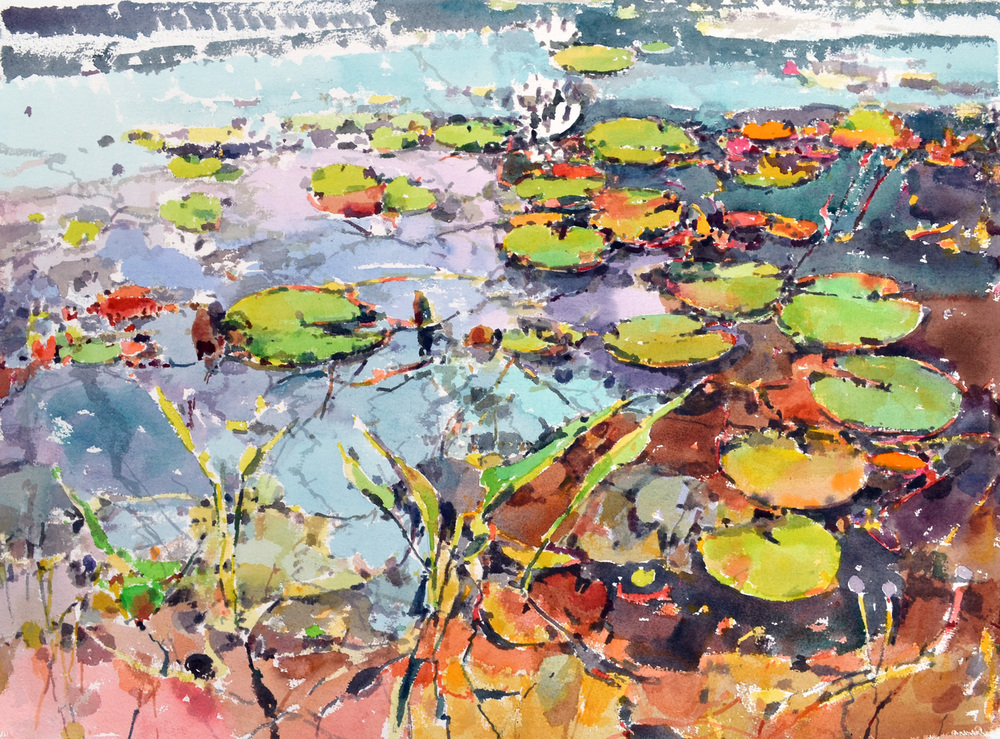
Why there are less abstract artists that use watercolor than oils or acrylics?
Once you stain that paper you have to live with that. Where when I’m doing an oil and I don’t like it I can wait until it dries and grind it off.
Where should an artist begin a piece?
You have to start somewhere. Most amateurs are afraid of white paper. To me it is just the opposite, I can’t wait to destroy it.
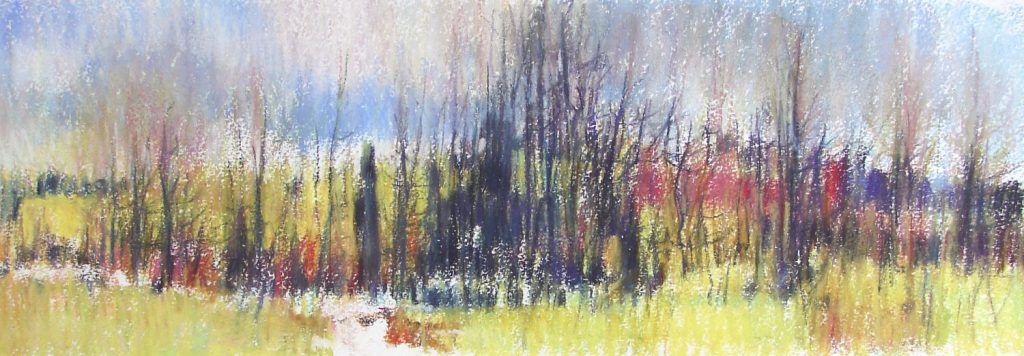
How do you deal with the frustration zone?
Any painter will tell you that at some point you will lose your place. Because it is everywhere but nowhere. You have to pull that thing together. Finding that anchor is important.
Does he hate money? His art with large canvas and a lot of pigment must be expensive.
It is just the opposite. The way to make a lot of money is big canvases.
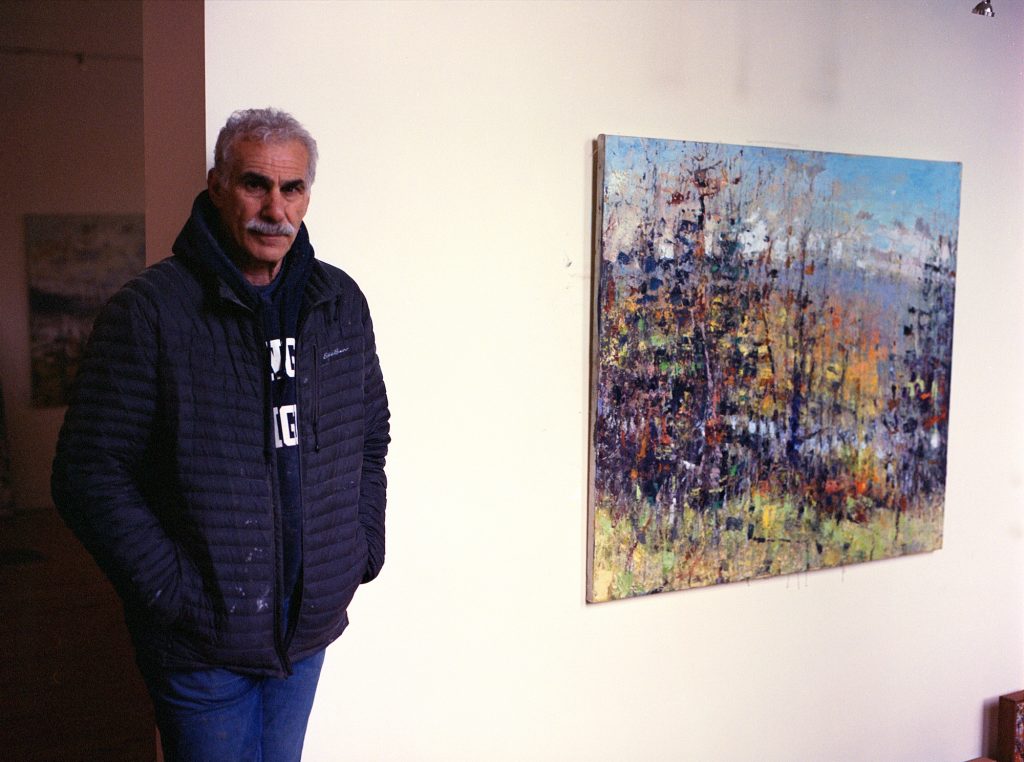
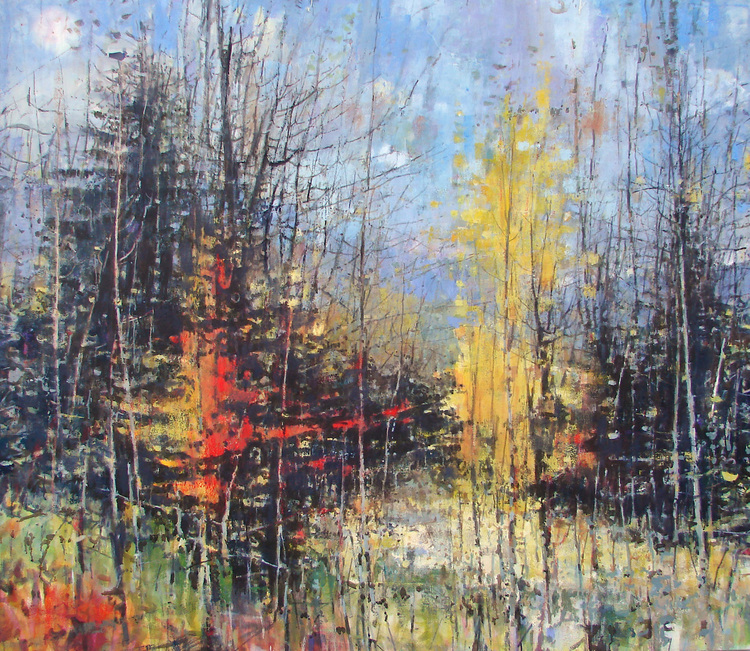
On the draw of abstract art?
There is a lot of bad abstract art. It is a lot harder to hit it. I always like at abstraction as… if it is going to work, Picasso did it, but you better know how to put it together before you take it apart.
On owning his own building for his gallery, studio, and workshop for decades.
Having this set me apart from a lot of things. It gave me a place to work and show, create revenue, to raise two kids. Having this building was everything.
Artists mentioned: Joe Opshinsky, Paul Mascatt, John Evans, Carlyn Evans, Fairfield Porter,and Edward Hopper.
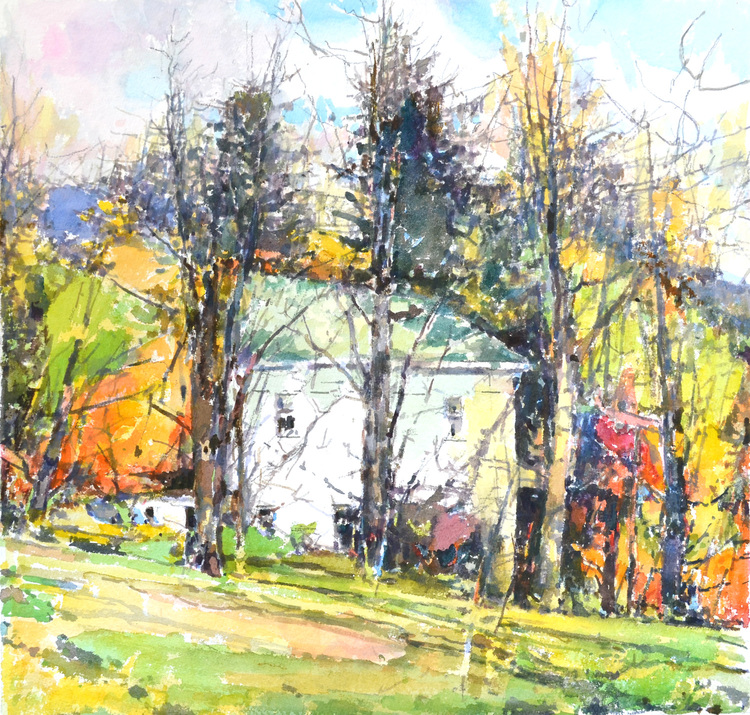
My thanks to William Chickillo of Skylake Gallery for taking the time to give my Dad and I a tour of his space and have this lovely conversation on a Saturday afternoon. You can follow William Chickillo on Instagram.
Photo credit: Colin Devroe.